"My God, my God why have you forsaken me?" Those words from Psalm 22 are very familiar
to most of us because they are the words Jesus quoted while he was dying on the
cross, and although we commonly think of there being seven last words of Christ
on Good Friday, in Mark's Gospel these words are the only ones that Jesus is
quoted as having said.
"My God my God why have you forsaken me?" shock us and confuse us. We ask ourselves,
"how could Jesus say such a thing?" If ever there was a man who had a
close intense relationship with God, it was Jesus. In fact, as Christians we
confess that Jesus was God, in the flesh. It doesn't make any sense to us at
all that Jesus would ever say such a thing.
That's what makes Good Friday such a troubling day of the
year for us who follow after Jesus, because in spite of the fact that we say,
"Jesus came into the world to be the lamb of God who takes away the sins
of the world," the fact is that he died a horrible, excruciating death,
being falsely accused and unjustly convicted,
surrounded and mocked by his enemies, and totally abandoned by his
disciples.
In contrast to Mark's Gospel, John's account of the
passion of our Lord does not even mention Jesus ' cry of dereliction. The
closest we get to any personal expression of suffering is just one single word
John does include: " I thirst."
Indeed, after all that Jesus went through, we do not doubt that Jesus
suffered a painful death. But when we hear the psalmist's words on Jesus lips,
as Mark tells the story, we come much
closer to the reality of what his suffering was really like.
As we ponder the mystery of the cross we wonder what it
must have been like for him to be
forsaken by God? What must it feel like to be forsaken by God? The psalmist's
experience gives us some insight into those types of feelings.
It is one thing to have never known God at all or to have
no memory of God having touched your life, but it is far worse to be
"abandoned " by the one you had relied upon for everything good. That
sense of loss increases the pain we feel and leaves us feeling completely
isolated and cut off from everyone. Our desolation leads to desperation, and
that leads to despair and hopelessness. No one in their right mind wants to be
there.
But that's exactly where Jesus was on Good Friday. He was
isolated, desolate, desperate, despairing, and hopeless.
We don't like to knowledge this fact about Good Friday.
It is much more pleasant for us to meditate on Jesus words "Father, forgive them, for they know not what they
do," or "Today you will be with me in paradise," or
"Father, into your hands I commit my spirit," or "I
thirst," or even "It is finished."
But when we hear Jesus cry out, "My God my God why
have you forsaken me?" we should not be filled with despair, because those
are words that give us real comfort when we think about them. We realize that if Jesus could feel that
level of intense pain and abandonment, then there is no pain or disappointment
or despair that we could possibly experience in our own lives that could
ultimately destroy us and separate us from the love of God in Christ Jesus.
Isn't that what St. Paul was referring to when he
described us as being united with Christ in a death like his? Our union with
Christ and his death and resurrection is something that gives us all a source
of hope, for, as Paul goes on to say, "if we have been united with him in
a death like his, we shall certainly be united with him in a resurrection like
his."
That is a triumph of the cross for all who believe and
are baptized. Apart from Christ's resurrection the story of the crucifixion of
our Lord is the ultimate sign of weakness and foolishness. It is sheer
hopelessness and despair for us. But, because God raised Jesus from the dead on
the third day, his cross becomes for us the true sign and symbol of God's
wisdom and power.
And that means that no matter how difficult life can
become for us, no matter how intense the suffering we may have to endure may be, no matter how overwhelming a
challenge we may have to face, we still have hope and we will still overcome because
Jesus borethe cross for us. Paul tells us, "he disarmed the rulers and
authorities and put them to open shame by triumphing over them in him."
"My God my God why have you forsaken me?" Is in
the and a very profound prayer arising from the depths of our human experience.
But in the cross of Christ we discover that in the end, like the psalmist, we
who fear the Lord will praise him, glorify him, and stand in awe of him because
he has not hidden his face from us, and he will always hear our cry.
It is that victory in Christ that makes this a
"Good" Friday for us and for all the world.
Saturday, April 7, 2012


Lessons on Footwashing
Today is Maundy Thursday, the first of the three days we call the
Triduum. It is an important day in some ways the most important of the three
days that we celebrate during holy week.
There are so many very important events that take place on this
particular day. Of course there is the last supper Jesus celebrated with his
disciples. But that event is followed shortly afterwards by Jesus trip to the
Garden of Gethsemane where he prayed in the garden that God might remove the
cup of suffering from him.That prayer is followed by the betrayal of Jesus by one of his own disciples, Judas Iscariot, and then his arrest by soldiers sent from the religious authorities of his day.
In rapid succession we hear about Jesus being put on trial by the religious authorities, and we hear about the encounter Peter had in the courtyard of the high priest with a servant girl who believed that he was one of Jesus followers. It was there that Peter denied Jesus three times as Jesus had predicted.
Finally, we hear the confrontation between the high priest and Jesus leading to Jesus' condemnation by the Sanhedrin.
As we gather here today, however, the Gospel lesson focuses us on the new commandment that Jesus gave to his disciples and the dramatic act he performed by washing his disciples’ feet.
The water Jesus in that footwashing experience is another one of the “Water Marks” God has given to us to teach us what it means to be faithful followers of Jesus and servants of God.
In some ways, however, it is washing the feet of others that is most difficult for contemporary Christians to deal with. The problem is not with the story itself, of course, but rather when it is when we try to reenact the washing of feet within the context of a worship service like today. Like Peter in the Gospel lesson itself, we find it very difficult to take off our shoes and socks and submit ourselves to that kind of ceremony.
What was Peter's problem? It was not that he didn't have dirty feet, but that he didn't really understand what Jesus was trying to accomplish by doing that particular act, and, in fairness to Peter, we must point out that was only after Jesus washed the disciples’ feet that he explained to them what it was really all about.
John tells us that after Jesus had washed their feet and put on his robe and returned to the table he said to them, "Do you know what I have done to you? You call me teacher and Lord, and you are right, that is what I am. So if I, your Lord and teacher, have washed your feet, you also ought to wash one another's feet. For I have set you an example, that you should do as I have done to you. Very truly, I tell you, servants are not greater than their master, nor are messengers greater than the one who sent them. If you know these things, you are blessed if you do them."
Jesus went on to explain to his disciples, " I am with you only a little longer. You will look for me; and as I have said to the Jews so now I say to you 'Where I am going you cannot come.' I give you a new commandment, that you love one another. Just as I have loved you, you should you also should love one another. By this everyone will know that you are my disciples, if you have love for one another."
Doesn't it seem ironic that Christians should have difficulty with the reenactment of the ceremony that Jesus himself performed on the night of his betrayal and arrest on the night before his crucifixion? We don’t have trouble with the other part of the Last Supper account, the sharing of the bread and the cup. This was the last opportunity our Lord and teacher had to teach a lesson to his disciples knowing that he would not be able to teach them any longer after this night. Don’t you think we should take it more seriously?
There are three basic lessons Jesus wanted to get across to his disciples and to us as the ones would follow after them in future generations. Each of these lessons is about something we need to learn if we are going to be faithful followers of Jesus and servants of God.
The first lesson is this. We need to learn how to be humble and how to receive what God wants to give us. That is a very difficult thing for us to understand. We have no trouble accepting the teaching of Scripture that it is more blessed to give than to receive, that is, of course, when are feeling generous toward others. We are proud people, and it is hard for us to actually receive from others, even from God.
That Jesus is trying to get across, however. It is important for us to be able to receive before we can really understand the value of giving to others. As Jesus says, servants are not greater than their masters. In order to be a faithful servant, we must be able to humble ourselves and receive from others what they have to offer. When we are serving others we are vulnerable, and we are not in control. When we are able to receive from others, then we can understand better what it is like to be the recipient of the grace we want to bestow on others. A true sense of humility enables us to give freely to others without having to impose our will on others.
The second lesson Jesus is trying to get across to us in this example of washing his disciples' feet is that it is important for us to actually serve others. We become true servants by serving. It’s as simple as that. They are the ones who need to be in control, not we.
By definition, serving others requires us to be open and willing to adapt to the needs of the person or persons we are trying to serve, but sometimes we are hesitant or reluctant to do so if their needs are not the kind of needs we are interested in serving.
We have to learn to think from the perspective of the one who is being served. I'm reminded of the cartoon of the little old lady standing on the street corner with a cane lifted up saying," If another Boy Scout tries to force me to cross the street, I'm going to bang him with this stick."
Sometimes we say we are willing to serve others, but instead we try to determine the terms and conditions of that service. What Jesus is saying to us is simply this, if you're willing to serve then simply serve. Don't be condescending towards those you are trying to serve.
Finally, Jesus is teaching us that the true service must come out our willingness to express our love for God by showing love to others. He says to his disciples, "I give you a new commandment, that you love one another. Just as I have loved you, you also should love one another." Because God loves us, we love others. That’s what it is all about.
Can you see what Jesus is trying to do here? He is trying to build a community that is founded upon self-giving love. He's not offering us a bunch of rules and regulations to obey. He's not supplying us with detailed job descriptions. Just the opposite, Jesus is pointing us to take an active part in creating an open future built upon loving relationships between those whom he has called together to be a sign of God's new creation in the world.
Jesus is showing us that we need to make a transition from being followers to being leaders who serve under his guidance in the power of the Holy Spirit for the sake of the kingdom of God. That night he knew that his life among them was coming to an end in just a few hours, but he also knew that his life would continue in them and through them for generations to come. By laying down his life for us on the cross, he was also lifting us up so that we might bear that cross ourselves and follow in the path that he has shown us.
So, if we want to be faithful to our Lord, we need to do what he tells us to do. We are humble servants, set apart by God’s grace to show his love in real time among the people to whom he sends us. When we are willing to do that, then his mission among us has come to its fulfillment.
Wednesday, July 6, 2011
THE CAUSEWAY
One of the truly peculiar features of the place called “Holy Island” is the means by which visitors gain access to the island. Unlike most islands I have ever known, where people “connect” with the island from the mainland by means of a bridge, tunnel, or ferry, the way to get to Holy Island is by driving across a causeway that is open to traffic for only six or seven hours at a time.
The disruption is caused by the fact that the ebbing and the flowing of the tides which literally come across the causeway make it completely impassible. Every day people enter the island only during those periods when the tide is out. The rest of the time the island is cut off completely.
Day after day this phenomenon is repeated as the tides ebb and flow. Those who do not heed the tidal schedule, do so at their peril.
I can’t help but see this as a sort of parable that describes what faith is like for people who are followers of Jesus Christ. Faith, like the tides, ebbs and flows. Sometimes we feel strongly connected to God, unshakeable, and fully connected to the power of God. At other times, however, that connection seems to disappear completely, and it happens when we are not expecting it to happen.When our faith “ebbs,” we feel like we’ve become completely cut off from God and we wonder what has gone wrong.
How important it is for us to find out the tidal “schedule” that affects our lives of faith so we do not all of a sudden find ourselves cut off from the One who once seemed so close.
The tides of faith ebb and flow. It’s essential for us to know that. But it’s even more important that we know that, regardless of whether the tide is “in” or “out,” the causeway still remains in tact, keeping us connected with the One who loves us more than life itself. If we can remember that, then we will be able to live all day, every day, on the Holy Island where God has placed us, and that will always make the difference.
The disruption is caused by the fact that the ebbing and the flowing of the tides which literally come across the causeway make it completely impassible. Every day people enter the island only during those periods when the tide is out. The rest of the time the island is cut off completely.
Day after day this phenomenon is repeated as the tides ebb and flow. Those who do not heed the tidal schedule, do so at their peril.
I can’t help but see this as a sort of parable that describes what faith is like for people who are followers of Jesus Christ. Faith, like the tides, ebbs and flows. Sometimes we feel strongly connected to God, unshakeable, and fully connected to the power of God. At other times, however, that connection seems to disappear completely, and it happens when we are not expecting it to happen.When our faith “ebbs,” we feel like we’ve become completely cut off from God and we wonder what has gone wrong.
How important it is for us to find out the tidal “schedule” that affects our lives of faith so we do not all of a sudden find ourselves cut off from the One who once seemed so close.
The tides of faith ebb and flow. It’s essential for us to know that. But it’s even more important that we know that, regardless of whether the tide is “in” or “out,” the causeway still remains in tact, keeping us connected with the One who loves us more than life itself. If we can remember that, then we will be able to live all day, every day, on the Holy Island where God has placed us, and that will always make the difference.

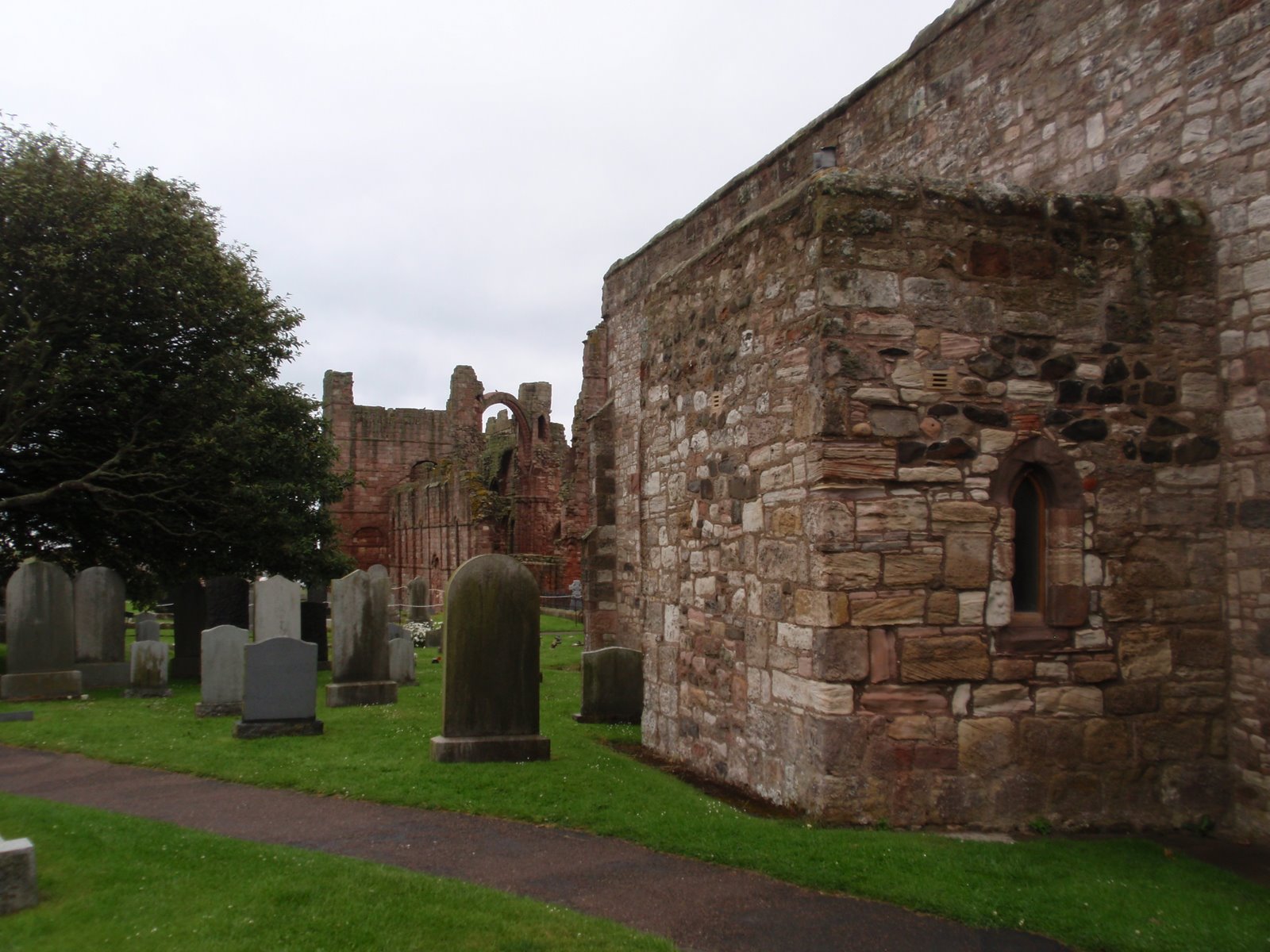
GRAVEYARDS OR GARDENS?


A common sight when visiting churches in the UK is the presence of graveyards that surround the parish churches. There’s nothing really strange or unusual about this. Churches are places where people have gathered together as communities of believers throughout their lives, and in many cases they include generations of believers who have lived in the parish for centuries.
It’s no wonder, then, that people might find their final repose in the same places.
It gives new meaning to the scripture in Hebrews that begins, “since we are surrounded by such a cloud of witnesses . . .” It is a testimony to the fact that in death, as in life, we are all bound together with one another.
Visiting such places like the Church of St. Mary’s on Holy Island (Lindisfarne), teaches us a lot about the nature of being a Christian. Each grave has a story, a story much longer than a single gravestone could express. But the mere fact that they are actually there, surrounding the parish church which was the center of their lives while they were living, tells us how powerful a force the gospel can be in a believer’s life. As Paul writes in Romans, “None of us lives to himself, and none of dies to himself. If we live, we live to the Lord, and if we die, we die to the Lord. So then, whether we live or whether we die, we are the Lord’s.”
At home in Selden, our church, like most other Lutheran churches, is not surrounded by the graves of saints. Rather, it is surrounded by an equally powerful symbol that conveys a valuable lesson about who we are as a company of believers.
Hope is surrounded by gardens. There are beautiful flowers planted by “anonymous saints” who care about the message we have to proclaim to our members and the larger community. They want people to experience some of the beauty of God in the place where the saints gather together.
It’s true, of course, that there are seasons when the flowers are gone and the beauty seems to disappear completely. Even the waterfall and the pond we have sometimes freeze up when the winter temperatures are too cold.
But then again, the ice doesn’t last forever. When spring arrives, the trees revive and the flowers return, often more robustly than the year before. That too is a sign from God, like the graves in the graveyards, and it tells us that death does not and will not prevail over us. From beginning to end our lives are in God’s hands.
Graveyards and gardens, both tell a story, especially when they surround the places where God’s people gather. We should not take either of them for granted.
To be honest, however, I must admit that I like gardens better.

Tuesday, July 5, 2011
Whitby Abbey Medieval Ruins
 HAIRCUTS AND HARD FACTS
 It feels strange to be away from our homeland on the 4th of July. But here we are, heading down to Whitby Abbey, the place where a major event took place that changed the course of the development of the life of the Christian movement in England.
The event is called the “Synod of Whitby,” a conference of clergy gathered by the King of Northumbria who wanted to settle issues that caused conflict among Christians in his kingdom.
The issues they debated had to do with two subjects we would never spend a moment thinking about: how to determine the correct date for observing Easter and what form of tonsure (haircutting) should be required for those who lived in monasteries.
Underneath those issues was a much larger concern. Prior to the Synod, there was a collision between the missionaries sent to England by the Church of Rome from southern England and the Celtic missionaries who were moving into England from the north. Both missionary efforts were meeting with some success, but their approaches to “missionizing” the people of England were diametrically opposed to one another.
Rome wanted to be in control of what was going on, and Rome wanted everyone to give obedience to the Pope. The Celts, on the other hand, did not see the need to be under papal authority, and they were successful in converting pagans to Christianity because they were able to adapt their methods to the conditions they met along the way.
The issues that caused conflict in that day are not much different from the issues that we need to deal with as Christians today if we are going to have any impact on the non-Christian environment in which we live and serve. Do we need to be under the control of those who would require conformity and obedience to their norms and values? Or would we be more effective in carrying out God’s mission if we were willing to focus on the mission itself without having to be constantly looking back to patterns and practices that are no longer effective in reaching people who are apart from the church?
The Celtic form of evangelism was effective because what mattered most to them was getting God’s mission accomplished. In a time when the Church in the Western Hemisphere is in such serious decline, we could see a different future if we were willing to learn from those who went before us.


Views of Bamburgh Castle and North Sea


 Today we visited a castle that was once a Castle for kings of Northumbria, the northern kingdom of England bordering Scotland. The castle goes back to Norman times, but a lot of reconstruction has taken place, especially during the Victorian era as seen in the photos.
The final photo is a sculpture of the priests who carried the body of Saint Cuthbert around Northern England prior to coming to its final resting place in Durham.


HAIRCUTS AND HARD FACTS
It feels strange to be away from our homeland on the 4th of July. But here we are, heading down to Whitby Abbey, the place where a major event took place that changed the course of the development of the life of the Christian movement in England.
The event is called the "Synod of Whitby," a conference of clergy gathered by the King of Northumbria who wanted to settle issues that caused conflict among Christians in his kingdom.
The issues they debated had to do with two subjects we would never spend a moment thinking about: how to determine the correct date for observing Easter and what form of tonsure (haircutting) should be required for those who lived in monasteries.
Underneath those issues was a much larger concern. Prior to the Synod, there was a collision between the missionaries sent to England by the Church of Rome from southern England and the Celtic missionaries who were moving into England from the north. Both missionary efforts were meeting with some success, but their approaches to "missionizing" the people of England were diametrically opposed to one another.
Rome wanted to be in control of what was going on, and Rome wanted everyone to give obedience to the Pope. The Celts, on the other hand, did not see the need to be under papal authority, and they were successful in converting pagans to Christianity because they were able to adapt their methods to the conditions they met along the way.
The issues that caused conflict in that day are not much different from the issues that we need to deal with as Christians today if we are going to have any impact on the non-Christian environment in which we live and serve. Do we need to be under the control of those who would require conformity and obedience to their norms and values? Or would we be more effective in carrying out God's mission if we were willing to focus on the mission itself without having to be constantly looking back to patterns and practices that are no longer effective in reaching people who are apart from the church?
The Celtic form of evangelism was effective because what mattered most to them was getting God's mission accomplished. In a time when the Church in the Western Hemisphere is in such serious decline, we could see a different future if we were willing to learn from those who went before us.
Subscribe to:
Posts (Atom)