Wednesday, July 6, 2011

GRAVEYARDS OR GARDENS?


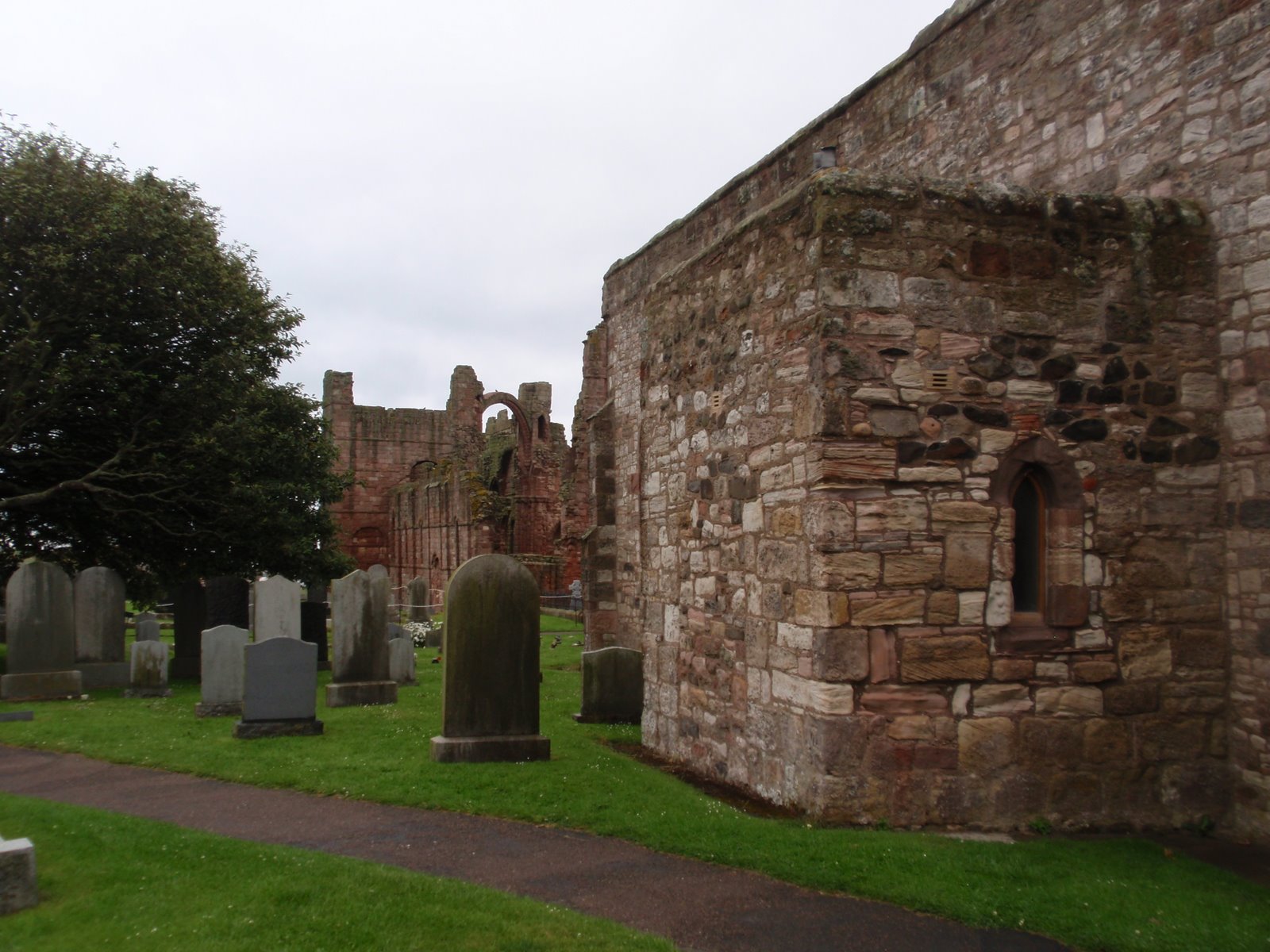
A common sight when visiting churches in the UK is the presence of graveyards that surround the parish churches. There’s nothing really strange or unusual about this. Churches are places where people have gathered together as communities of believers throughout their lives, and in many cases they include generations of believers who have lived in the parish for centuries.

It’s no wonder, then, that people might find their final repose in the same places.
It gives new meaning to the scripture in Hebrews that begins, “since we are surrounded by such a cloud of witnesses . . .” It is a testimony to the fact that in death, as in life, we are all bound together with one another.

Visiting such places like the Church of St. Mary’s on Holy Island (Lindisfarne), teaches us a lot about the nature of being a Christian. Each grave has a story, a story much longer than a single gravestone could express. But the mere fact that they are actually there, surrounding the parish church which was the center of their lives while they were living, tells us how powerful a force the gospel can be in a believer’s life. As Paul writes in Romans, “None of us lives to himself, and none of dies to himself. If we live, we live to the Lord, and if we die, we die to the Lord. So then, whether we live or whether we die, we are the Lord’s.”

At home in Selden, our church, like most other Lutheran churches, is not surrounded by the graves of saints. Rather, it is surrounded by an equally powerful symbol that conveys a valuable lesson about who we are as a company of believers.

Hope is surrounded by gardens. There are beautiful flowers planted by “anonymous saints” who care about the message we have to proclaim to our members and the larger community. They want people to experience some of the beauty of God in the place where the saints gather together.

It’s true, of course, that there are seasons when the flowers are gone and the beauty seems to disappear completely. Even the waterfall and the pond we have sometimes freeze up when the winter temperatures are too cold.

But then again, the ice doesn’t last forever. When spring arrives, the trees revive and the flowers return, often more robustly than the year before. That too is a sign from God, like the graves in the graveyards, and it tells us that death does not and will not prevail over us. From beginning to end our lives are in God’s hands.

Graveyards and gardens, both tell a story, especially when they surround the places where God’s people gather. We should not take either of them for granted.

To be honest, however, I must admit that I like gardens better.
Posted by Picasa

Tuesday, July 5, 2011

Whitby Abbey Medieval Ruins

HAIRCUTS AND HARD FACTS
It feels strange to be away from our homeland on the 4th of July. But here we are, heading down to  Whitby Abbey, the place where a major event took place that changed the course of the development of the life of the Christian movement in England.

The event is called the “Synod of Whitby,” a conference of clergy gathered by the King of Northumbria who wanted to settle issues that caused conflict among Christians in his kingdom.

The issues they debated had to do with two subjects we would never spend a moment thinking about: how to determine the correct date for observing Easter and what form of tonsure (haircutting) should be required for those who lived in monasteries.

Underneath those issues was a much larger concern. Prior to the Synod, there was a collision between the missionaries sent to England by the Church of Rome from southern England and the Celtic missionaries who were moving into England from the north. Both missionary efforts were meeting with some success, but their approaches to “missionizing” the people of England were diametrically opposed to one another.

Rome wanted to be in control of what was going on, and Rome wanted everyone to give obedience to the Pope. The Celts, on the other hand, did not see the need to be under papal authority, and they were successful in converting pagans to Christianity because they were able to adapt their methods to the conditions they met along the way.

The issues that caused conflict in that day are not much different from the issues that we need to deal with as Christians today if we are going to have any impact on the non-Christian environment in which we live and serve. Do we need to be under the control of those who would require conformity and obedience to their norms and values? Or would we be more effective in carrying out God’s mission if we were willing to focus on the mission itself without having to be constantly looking back to patterns and practices that are no longer effective in reaching people who are apart from the church?

The Celtic form of evangelism was effective because what mattered most to them was getting God’s mission accomplished. In a time when the Church in the Western Hemisphere is in such serious decline, we could see a different future if we were willing to learn from those who went before us.


Posted by Picasa

Views of Bamburgh Castle and North Sea


Today we visited a castle that was once a Castle for kings of Northumbria, the northern kingdom of England bordering Scotland. The castle goes back to Norman times, but a lot of reconstruction has taken place, especially during the Victorian era as seen in the photos.

The final photo is a sculpture of the priests who carried the body of Saint Cuthbert around Northern England prior to coming to its final resting place in Durham.


Posted by Picasa

HAIRCUTS AND HARD FACTS

It feels strange to be away from our homeland on the 4th of July. But here we are, heading down to Whitby Abbey, the place where a major event took place that changed the course of the development of the life of the Christian movement in England.

The event is called the "Synod of Whitby," a conference of clergy gathered by the King of Northumbria who wanted to settle issues that caused conflict among Christians in his kingdom.

The issues they debated had to do with two subjects we would never spend a moment thinking about: how to determine the correct date for observing Easter and what form of tonsure (haircutting) should be required for those who lived in monasteries.

Underneath those issues was a much larger concern. Prior to the Synod, there was a collision between the missionaries sent to England by the Church of Rome from southern England and the Celtic missionaries who were moving into England from the north. Both missionary efforts were meeting with some success, but their approaches to "missionizing" the people of England were diametrically opposed to one another.

Rome wanted to be in control of what was going on, and Rome wanted everyone to give obedience to the Pope. The Celts, on the other hand, did not see the need to be under papal authority, and they were successful in converting pagans to Christianity because they were able to adapt their methods to the conditions they met along the way.

The issues that caused conflict in that day are not much different from the issues that we need to deal with as Christians today if we are going to have any impact on the non-Christian environment in which we live and serve. Do we need to be under the control of those who would require conformity and obedience to their norms and values? Or would we be more effective in carrying out God's mission if we were willing to focus on the mission itself without having to be constantly looking back to patterns and practices that are no longer effective in reaching people who are apart from the church?

The Celtic form of evangelism was effective because what mattered most to them was getting God's mission accomplished. In a time when the Church in the Western Hemisphere is in such serious decline, we could see a different future if we were willing to learn from those who went before us.

Thursday, June 30, 2011

STRATEGY FOR MISSION

The Island of Iona is a small, quiet, and very beautiful place. It is reached from the Scottish mainland by taking an hour-long ferry ride to the Island of Mull, then followed by another hour of driving to the far end of the Isle of Mull on a one-lane two-way road to a place called Fionnphort to another ten-minute "Shelter Island"-type ferry to Iona. A brief walk from the ferry slip and you are at the Abbey (just beyond the St. Columba hotel where we are lodging).

Back in the 6th century an Irish Monk got into a dispute over a manuscript that eventually led to a bloody conflict between Christians. To make amends for the loss of life, he offered to go to Scotland to convert the pagan people there to Christianity. He had founded monasteries earlier, so he used that method as a strategy for carrying out his mission in the new land he was sent to.

On Iona he started a monastery where copying manuscripts became a major enterprise for the monks who came to live there. At the same time he taught the monks so they could become evangelists for the gospel, turning the monastery into a center for Christian learning and preparation for missionary work. Many people became Christians as a result of his work.

I have often commented on how important it is for pastors to be trained for the work of evangelization. On my "business card" I have the title "Pastor/Mission Developer" to describe how I see my job. I would love to see our synod take seriously the need to re-train our clergy so we can provide the leadership so desperately needed for the work of the gospel in the largely pagan mission field of Metropolitan New York. Saint Columba could be a source of inspiration for such a strategy for mission if we could find the courage to follow his example for ministry.

CROSSING OVER

Having missed a day because of an internet problem in Glasgow, I am getting ready for the journey to Iona.

It's a "journey" because getting to Iona is more of a challenge than going to other places. First, a cab. Then a ferry to Mull Island where we take a cab across the island (50 minutes) to another ferry that brings us to the island where we will be met by people who will assist us in getting our gear over to St. Columba's hotel.

But it's also a journey because of the spiritual character of the visit to this island which has been a Christian holy place since the 563 A.D. when St. Columba came from Ireland to establish a monastery there. It became a center for learning and a place where some highly important documents were produced including, possibly, the illuminated manuscript collection of the four gospels called the Book of Kells was started around 800 A.D.

I have been told that the journey is even more significant than its historic roots imply because it is also a place where the prayers of Christians have been lifted up continually for centuries, embracing and enfolding many who have come to spend time as part of the ecumenical community that lives there.

I am learning about Celtic Christianity, a way of living in communion with God and God's creation that joins them together rather than separating them as many Christians do.

Our visit to Glasgow included a visit to Glasgow Cathedral, a beautiful ancient building which was built based on the story of Saint Mungo. It survived the iconoclastic efforts of Scottish reformers of the 16th century, and it includes features that characterize cathedrals of the early Middle Ages. It is no longer technically a "cathedral" because it is a Presbyterian Church, and Presbyterians do not have bishops.

Monday, June 27, 2011

SAINT ANDREW, I PRESUME

Today's journey brought us two hours away from Edinburgh to a beautiful coastal town called "Saint Andrews." To some of us the place is important because of the influence it had on Christian history in Scotland. To others it is best known as the "Home of Golf," where the sport took root and from which most of the rules of the sport are generated, and to still others it is known best as the place where Prince William and Princess Kate met.

A highlight of the visit is the ruins of the cathedral that was begun in 1160 and finally consecrated in 1318. It was the largest cathedral built in Scotland, located near an older church built by Saint Rule who brought what were believed to be the remains of Saint Andrew the Apostle to the town. We climbed the tower that still remains that was in the center of St. Rule's church building, a climb of at least 150 steps.

After visiting the Castle of St. Andrews, a place that played a role in the Scottish Reformation, we walked over to the St. Andrews Golf Course where we had High Tea together to celebrate the birthday of Pastor Kathleen Koran, an Assistant to our bishop.

As I think about the places we visited today, I can't help but see the contrast between the values that were once so important to people and the values people have today. Saint Andrew was never in Scotland, of course, but his remains were—a reminder to the Scottish people of the brother of Saint Peter. He played an essential role in the gospels by pointing his brother to Jesus. He was also included among the closest followers of Jesus. Ultimately, according to tradition, he was executed by crucifixion on an "X-shaped" cross, giving rise to the symbol which is on the Scottish flag.

By contrast we have the home of golf, a sport which is popular among many, even on Sunday mornings. It is a time-consuming sport, and it is not inexpensive. It takes real commitment to be a dedicated golfer.

I wonder what the church would be like if followers of Jesus showed the same level of commitment to Christ that golfers show to their sport. Would it make a difference in the way the church impacts society?

A visit to Saint Andrews raises some interesting thoughts for me.